 Electro
Java4Shell Explained: The OpenJDK Bug That Only Hits Certain CPUs
Java4Shell (CVE-2026-114938) is an OpenJDK flaw that can take over Java servers — but only on AVX-512 CPUs. Plain explainer, a safe check, and how to patch.
On this page
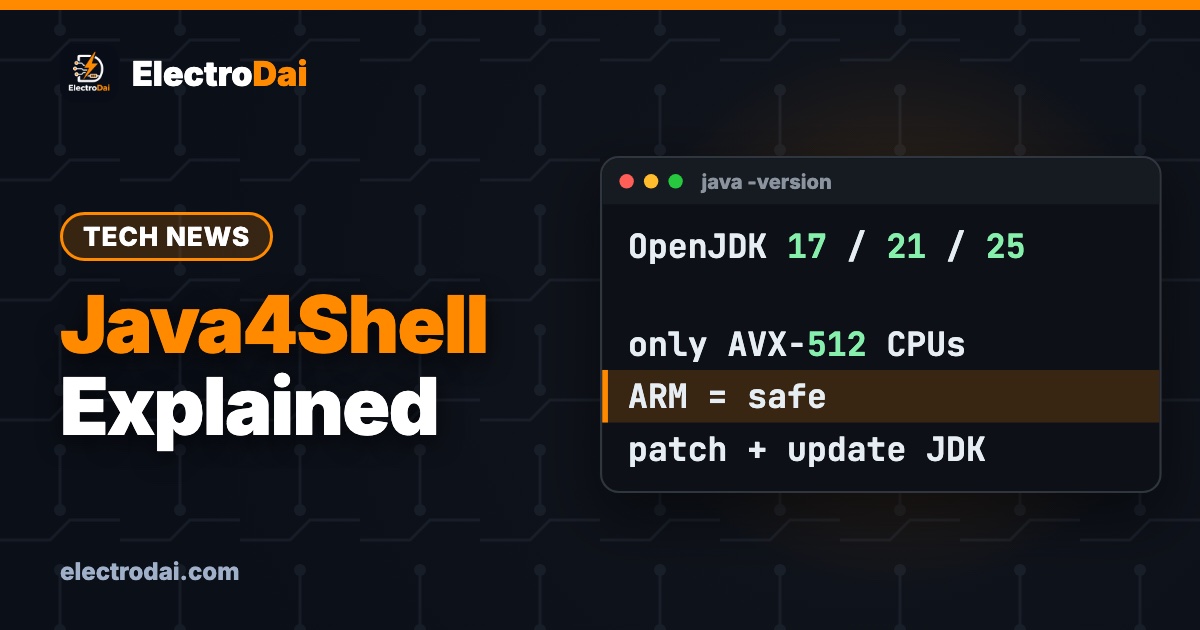
In mid-November 2026, researchers disclosed a nasty flaw in OpenJDK, the open-source engine behind most of the world's Java applications. The nickname is Java4Shell, an echo of the famous Log4Shell scare, and it can let an attacker take over a Java server with no login. Big enterprise tools — Jira, Jenkins, Keycloak and others — are in the firing line. But there is an unusual twist that makes this bug very different from a "panic now" emergency.
This is ElectroDai's plain-English guide for students and developers in Nepal. No attack code — just what Java4Shell is, the one detail that decides whether you are even exposed, a safe self-check, and how to patch. If you run anything built on Java, read on.
What is Java4Shell, in simple words?
Java has a built-in feature for decoding Base64, a common way of packing data into text (think of the long strings inside tokens and config files). To go fast, modern Java uses special CPU turbo instructions called AVX-512 to decode that text. The bug lives in that fast path: a carefully sized input makes Java write about 62 bytes past the end of the space it reserved — a classic heap overflow. Java notices the input is invalid and rejects it, but only after it has already scribbled over memory it shouldn't have. An attacker who controls that overflow can steer the program into running their code.
The official ID is CVE-2026-114938, rated 9.2 out of 10 by the researchers (Oracle scores it a bit lower at 8.1). Because almost every web app accepts Base64 somewhere, the attack surface is huge.
The twist: it only affects some CPUs
Here is what makes Java4Shell unusual. The vulnerable turbo code only runs on processors that support a feature called AVX-512 VBMI. In practice:
- Affected: newer data-center chips — Intel Xeon from Ice Lake onward, and AMD EPYC from Zen 4 onward.
- Not affected: older x86 servers (Skylake, Cascade Lake, AMD before Zen 4), most laptops and desktops, and — importantly for cloud hobbyists — all ARM processors. That includes Apple Silicon Macs and the ARM-based free-tier servers from Oracle Cloud and others.
So a Java app on an ARM server simply does not run the buggy path. That is why one research team titled their write-up "easy to crash, hard to exploit" — the conditions have to line up for a real takeover.
Which Java versions are affected?
The fast Base64 path arrived around OpenJDK 17.0.6, so the modern long-term-support lines are in scope: Java 17, 21 and 25 (and newer). Oracle shipped fixes in its November 2026 security update, and the OpenJDK project's patch is a tiny length check (JDK-8393212). Downstream builds — Temurin, Amazon Corretto, Azul, Red Hat — follow with their own patched releases.
Am I affected? A safe self-check
Two safe, read-only checks. You are only inspecting your own setup.
1. Check your Java version (SSH or terminal):
java -version
Note the version (for example 17.0.9) and compare it to your vendor's patched release.
2. Check whether your CPU even runs the risky path (Linux):
lscpu | grep -o avx512vbmi
If this prints avx512vbmi, your CPU can run the vulnerable code — patch promptly. If it prints nothing, your processor lacks the feature and the takeover path is closed (though patching is still good hygiene). On an ARM server, there is no AVX-512 at all, so you are not exposed to this one.
How to fix it
Patch (best option): update your JDK to the vendor release that contains the CVE-2026-114938 fix, then restart your Java services. Match the branch you are on — a patched 17.x, 21.x or 25.x.
Can't patch right away? On an x86-64 host only, you can turn off the AVX-512 fast path when starting your app:
java -XX:UseAVX=2 -jar yourapp.jar
This disables the vulnerable turbo code at a small speed cost. Do not use this flag on ARM servers — ARM Java ignores it and the app will fail to start. Treat it as a bridge until you can apply the real patch.
After patching or applying the flag, confirm your app still starts and serves normally.
What this means for you as a student
If you are learning Spring Boot, running a Jenkins build server, or hosting any Java API for a college project, this is a useful real-world lesson in how modern vulnerabilities work — and in why "what hardware am I on?" is now a security question, not just a performance one. A few takeaways:
- Know your stack down to the CPU. The same Java app is exposed on a new Xeon and safe on a Raspberry Pi. Details matter.
- ARM free-tier servers (like Oracle Cloud's) dodge a whole class of x86-only bugs — a quiet bonus of the hardware you may already be using for free.
- Keep your JDK current. Whether it is Temurin or Corretto, let the updates flow; the next Java4Shell will be closed before you even read about it.
FAQ
Does Java4Shell affect Android apps?
Android uses its own runtime (ART), not server OpenJDK, and phones are ARM — so this particular flaw does not hit your Android apps. Server-side Java backends are the real concern.
I run Java on an ARM server. Am I safe?
From this specific bug, yes — ARM has no AVX-512, so the vulnerable code never runs. Still apply the patch when it is convenient, so you are covered everywhere and not relying on one hardware detail forever.
Is this as bad as Log4Shell was?
The potential impact is similar — pre-auth takeover of Java servers — but the CPU requirement makes it far narrower. One study estimated only a small fraction of running Java servers are truly exploitable. Serious, but not the internet-wide fire drill Log4Shell was.
Sources
Based on the OpenJDK and Oracle November 2026 advisories and reporting from VulnCheck, Wiz, Qualys and SecurityWeek (17–18 November 2026). Follow your JDK vendor's advisory for the exact patched version for your build.

NGINX2Root Explained: 5 Critical NGINX Flaws and How to Check Your Server
NGINX2Root (CVE-2026-123007 + 4 more) can crash or take over NGINX web servers. Simple explainer, a safe version check, and how to patch to 1.31.9 / …

PHP2Shell Explained: The Critical PHP Bug and How to Check If You Are Safe
PHP2Shell (CVE-2026-109618/109619) lets attackers take over PHP servers. Plain-English explainer, a safe check for your own site, and how to patch.